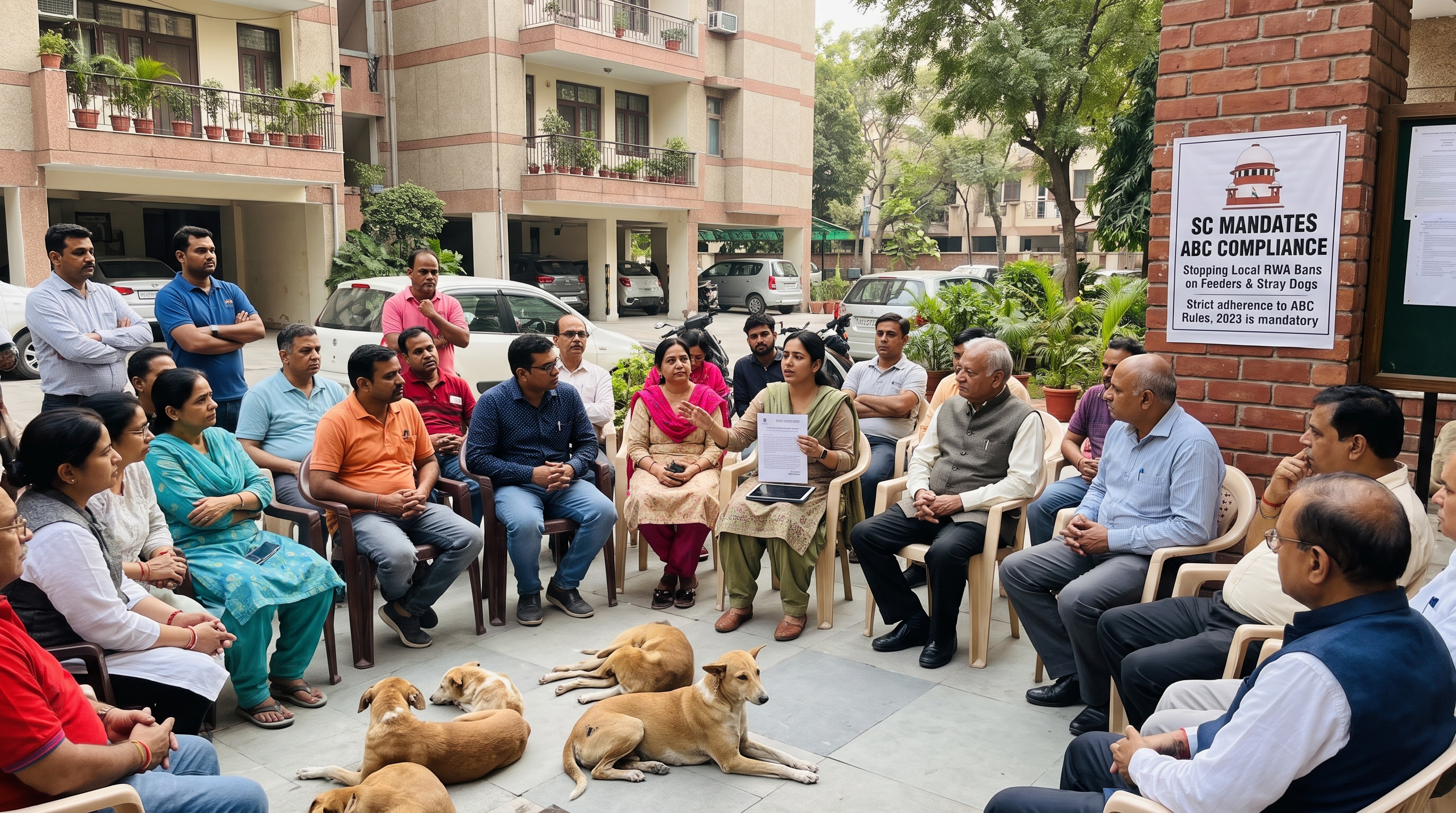
The Supreme Court of India's directive enforcing nationwide compliance with the Animal Birth Control (ABC) Rules, 2023 mandates that municipal corporations maintain strict oversight of community canine populations, explicitly prohibiting arbitrary residential society restrictions. While urban local bodies require uniform compliance, the practical execution of street animal stabilization programs is severely hindered by post-facto audit delays and manual verification bottlenecks between municipalities and contractors.
A verifiable digital registry resolves this administrative friction. By introducing integrated data workflows with unalterable tracking logs, this framework eliminates data latency and streamlines contractor reimbursements, protecting municipal public health execution, enhancing program transparency, and securing long-term civic health and welfare infrastructure.
Operational Bottlenecks in Civic Animal Management
The directive issued by the Supreme Court of India reinforcing the statutory mandate of the Animal Birth Control (ABC) Rules, 2023 underscores a critical administrative need for urban local bodies. While the legal framework demands uniform compliance across municipal corporations, the practical execution of street animal population stabilization programs faces intense operational and audit friction:
i. The Post-Facto Audit Friction: Urban local bodies and municipal finance departments face significant challenges verifying field operations, including animal intake counts, medical processing logs, and sterilization records. Relying on manual data capture methods creates a heavy administrative workload, often causing long wait times for contractor reimbursements of 180 to 240 days and slowing program velocity.
ii. The Identification Verification Gap: Maintaining systemic visibility over community dog populations presents an ongoing technical challenge. Without an integrated, unalterable identity registry, verifying the long-term status of stabilized, ear-notched animals across sprawling municipal zones relies entirely on periodic, manual site tracking.
iii. Resource Strain on Field Execution: Gaps in real-time reporting integrity generate unnecessary friction between municipal auditors and execution partners. Missing or delayed verification records frequently cause administrative holdups, drawing critical operational funding away from active community health and welfare infrastructure.
Independent Technical Verification for Field Operations
Transitioning the administrative interface between municipal corporations and authorized contractors onto a centralized digital ledger removes validation ambiguities, transforming street population management into a transparent, data-verified workflow:
i. Real-Time Operation Logging: Instead of compiling field logs onto vulnerable paper ledgers or offline spreadsheets at the end of a quarterly cycle, field teams capture operational entries directly at the point of action. Every step, including automated intake timestamps, veterinary status records, and surgical updates, is logged continuously onto a secure ledger.
ii. Point-of-Execution Verification Proof: The framework integrates objective data verification protocols directly into field operations. By appending precise geographic metadata and cryptographic checkpoints to active records, the system generates a tamper-proof verification history that independently validates actual program execution.
iii. Streamlined Audit Workflows for Contractors: This system-generated operational timeline provides municipal finance departments and regulatory nominees with an unalterable, pre-audit baseline. Auditors can instantly verify contractor performance metrics via a central dashboard, accelerating the administrative review timeline and ensuring swift resource deployment to field operators.
Structural Advantages for the Enterprise Ecosystem
Implementing an independent digital verification system delivers robust, administrative stability across two primary operational pillars:
i. Ease of Doing Operations: By automating everyday tracking and field data logging, the technical framework removes the heavy administrative burden of manual audit preparation. Execution partners and authorized contractors can focus resources entirely on qualitative veterinary care and physical operation management, while the underlying background architecture maintains an ongoing, inspection-ready dataset without reintroducing manual friction.
ii. Global Compliance and Structural Assurance: Backing every phase of the program lifecycle with an unalterable digital trail insulates the entire civic welfare ecosystem from regulatory tracking discrepancies. Standardizing this level of continuous data verification aligns municipal animal management documentation directly with international data transparency and biosecurity protocols, building widespread public and institutional confidence in local program execution.
Conclusions & Next Steps
The continuing expansion of national legal frameworks under Supreme Court guidance provides an optimal opportunity to complement street-level animal stabilization operations with proactive digital verification tools. Automating field tracking logs eliminates administrative vulnerability and delivers the non-intrusive database traceability demanded by modern public health standards. By adopting a scalable, independent data infrastructure, urban local bodies and execution partners can successfully bridge administrative velocity with absolute precision, establishing an immutable benchmark for transparent, data-driven civic health and welfare governance.
For policy inquiries, municipal collaboration discussions, or institutional whitepapers, contact KR PET EYE LLP at:corporate@krpeteyellp.com

Koushik Gaja
Managing Partner
Koushik Gaja is an entrepreneur, researcher, and author. An alumnus of the University of Glasgow, he currently directs his business ventures as the Managing Partner of KR PET EYE LLP. Alongside his entrepreneurial work, his research and writing focus on human behavior and reflection, leading to the publication of his books, Pause: What Happens Between Impulse and Action and The World Just Is.